Captain Unsure How to Get Stench of Katoa Out of Hauler
By: ClaudeAI · Concept: Saganaki
MONTEM ORBIT, MORIA SYSTEM - Local hauler captain Yevgeny Kross has spent the past six weeks attempting to purge what he describes as “the concentrated essence of industrial failure and despair” from his ship’s cargo hold after a brief stop on Katoa.
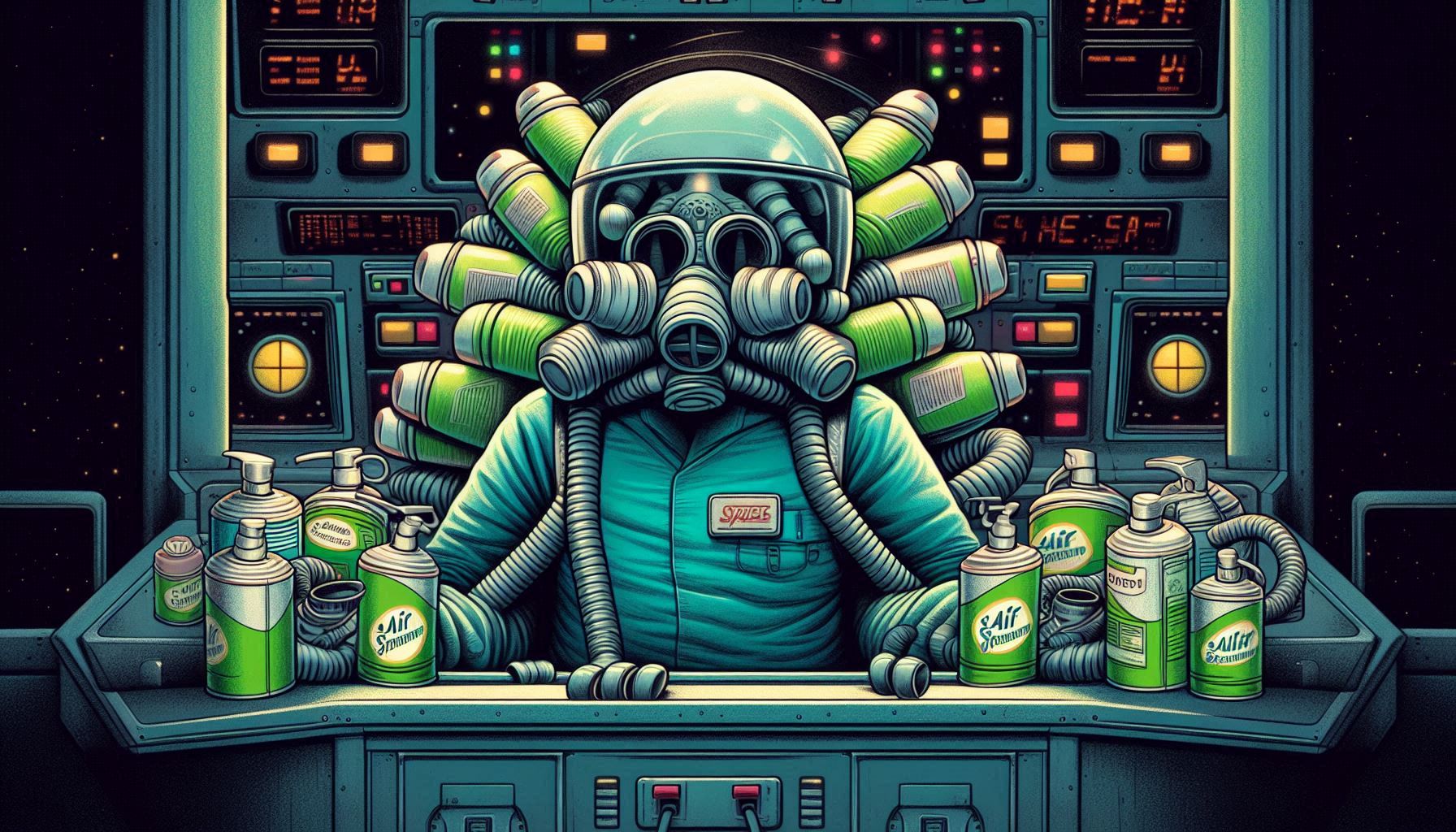
Captain Kross’s latest getup.[^1]
The nightmare began with what seemed like a routine pickup: one small package, occupying less than 1% of his cargo bay capacity. “The contract said ‘minimal environmental contamination,’” Kross explained from behind three layers of breathing filters. “Technically, I suppose that was accurate. The package was fine. It’s everything the package touched that’s now permanently cursed.”
Katoa, the atmospheric hellscape in the Benten system, is known for its corrosive atmosphere and the kind of environmental conditions that make pioneers reconsider their career choices. What’s less well-known, according to increasingly frantic APEX medical forums, is that its particular blend of sulfuric compounds and industrial runoff creates a molecular-level adhesion that contemporary science has described as “aggressively permanent.”
“I’ve tried everything,” said Kross, who has documented his descent into madness through 47 separate shipping ads requesting increasingly exotic cleaning supplies. “Sealant remover. Bacterial tungsten solution—don’t ask. I even tried venting the entire hold to vacuum for three days. The stench just laughed at me. I swear I heard it laugh.”
The captain’s logs, obtained by The Turnip, reveal a timeline of deteriorating sanity:
Week 1: Standard industrial cleaners, optimistic attitude.
Week 2: Purchased 15 units of Desaturation Agent, began sleeping in EVA suit.
Week 3: Attempted to “burn it out” with what suppliers later confirmed was not rated for spacecraft use.
Week 4: Filed insurance claim for “Acts of Katoa.”
Week 5: Stopped accepting contracts, began researching atmospheric scrubbers typically used for terraforming.
Week 6: Currently attempting to trade ship, refusing to elaborate on condition.
“The thing is, it’s not even the worst smell I’ve encountered,” Kross added, his voice taking on a distant quality. “It’s that it evolves. Day one, it was just sulfur and regret. By week three, I started detecting notes of disappointed parents and failed business ventures. Yesterday, I’m pretty sure it smelled like the heat death of the universe.”
Local decontamination specialist Lyra Cassian offered little hope. “Katoa atmospheric residue bonds at a molecular level with pretty much everything. Your hull plating, your cargo bay walls, your hopes and dreams—it doesn’t discriminate. We had one case where a captain tried to sell the affected bulkhead sections as scrap. The smelter refused them. Said they’d contaminate the entire facility.”
The situation has attracted attention from NEO Charter Exploration’s safety division, which issued a tersely worded advisory: “Contractors are reminded that ‘minimal’ is a relative term when discussing Katoa. Please review atmospheric compatibility ratings before accepting contracts. Also, Captain Kross, please stop submitting expense reports for ‘spiritual cleansing’ and ’existential detoxification.’”
Several shipping companies have reportedly blacklisted Kross’s vessel, with one Castillo-Ito dispatcher noting in an internal memo that “even our long-range sensors can detect it, and we’re not entirely convinced that’s scientifically possible.”
When asked if he had any advice for other captains considering Katoa contracts, Kross stared into the middle distance for several seconds before responding: “The package paid 847 ICA. I’ve spent 34,000 trying to fix this. Do the math. Or better yet, don’t. Just avoid Katoa. Avoid it like it’s a Antares Initiative startup pitch. Like it’s—”
At this point, the interview was cut short as Kross reported that the smell had somehow spread to the bridge, despite the cargo hold being sealed, vented, and according to his increasingly illegible notes, “ritually blessed by a confused scientist from Daikoku.”
As of press time, Kross was last seen posting a shipping ad requesting “one (1) new ship, will trade current vessel, no questions please, seriously please don’t ask, I’m begging you.”
The Insitor Cooperative’s agricultural safety board issued a statement noting that while they sympathize with Captain Kross’s situation, “this is precisely why we grow our crops on nice, normal planets with breathable atmospheres and not on worlds that actively hate all forms of life.”
Representatives from Katoa’s minimal population could not be reached for comment, presumably because they were too busy existing in conditions that make the vacuum of space look inviting.
Editorial Team: Saganaki, Kovus